

Pagkatapos ng isang kasong kriminal, maaari ka pa ring humingi ng kabayaran mula sa nagkasala sa ilalim ng batas sibil ng Netherlands, kahit na hindi iginawad ng korte kriminal ang iyong kahilingan o walang anumang pag-uusig. Ang pangunahing eksepsiyon: kung napagpasyahan na ng korte kriminal ang iyong kahilingan batay sa mga merito, hindi mo na maaaring iharap muli ang parehong kahilingan sa korte sibil.
Under Article 161 of the Dutch Code of Civil Procedure (Rv), a final criminal conviction is binding evidence in later civil proceedings that the convicted person committed the offence. The offender may try to prove otherwise, but that rarely succeeds, so a conviction does most of the evidential work in a civil claim.
Law & More does not handle personal injury claims (letselschade). If your claim mainly concerns physical or psychological injury, we refer that part to a specialised personal injury lawyer; we assist with the criminal case and with other civil claims.
What rights do victims have under Dutch law?

As a victim you can claim compensation from the offender, in the criminal case and in separate civil proceedings, and you have rights to information, protection and support. The rights in the criminal process are laid down in Articles 51a to 51h of the Dutch Code of Criminal Procedure (Sv), which implement European Directive 2012/29/EU on victims’ rights.
Who counts as a victim?
Under Article 51a Sv, a victim is a person who has suffered financial loss or other damage as a direct result of a criminal offence. Both natural persons and companies can be victims; if the victim has died, close relatives such as the spouse or registered partner, children, parents, brothers and sisters can exercise certain rights.
Paano nagkakaiba ang mga kasong sibil at kasong kriminal?
Criminal proceedings are about guilt and punishment and are led by the Public Prosecution Service (Openbaar Ministerie, OM). Civil proceedings are about compensation, and you as claimant decide whether and when to sue, what you claim and whether to settle.
The rules of evidence also differ. In a criminal case the court must be convinced, on lawful evidence, that the suspect committed the offence (Article 338 Sv). In a civil case the party relying on a fact must prove it (Article 150 Rv) and the court assesses the evidence freely, so a civil claim can succeed even after an acquittal.
Which routes to compensation do you have?
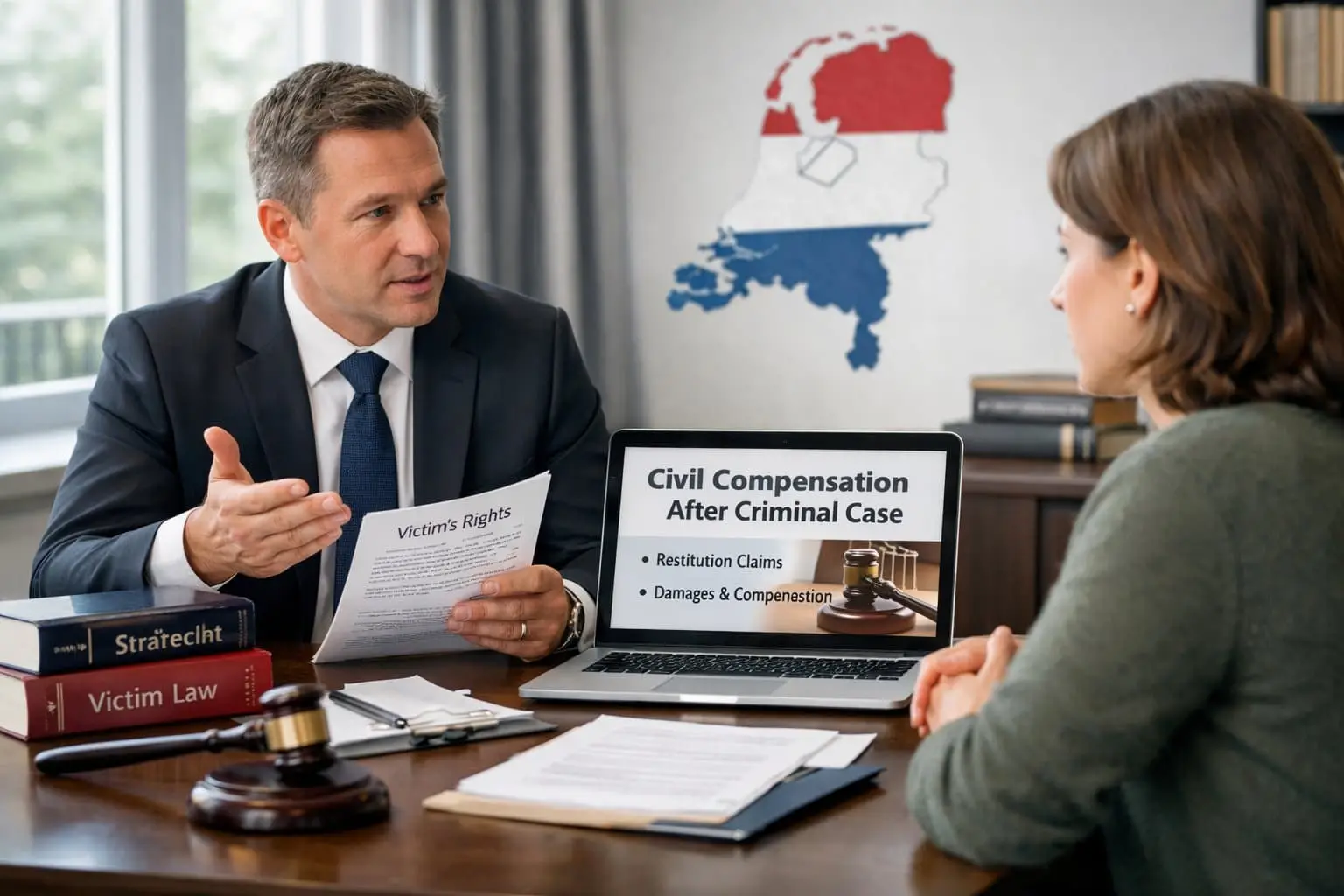
Mayroon kang tatlong paraan upang maghain ng danyos : pagsali sa kasong kriminal bilang isang nasugatang partido, isang hiwalay na sibil na paghahabol, o isang aplikasyon sa Violent Offences Compensation Fund. Maaari itong bahagyang pagsamahin, ngunit hindi ka mababayaran nang dalawang beses para sa parehong pagkalugi.
| Ruta | Mga Gastos | Pangunahing kalamangan | Pangunahing limitasyon |
|---|---|---|---|
| Pagsali sa kasong kriminal | Walang bayad sa korte | Mabilis; ang Estado ang nangongolekta ng kabayaran | Mga simpleng pag-aangkin lamang; ang mga kumplikadong bahagi ay idineklarang hindi katanggap-tanggap |
| Sibil na paglilitis | Mga bayarin sa korte at mga gastos sa abogado | Angkop para sa mga kumplikado at malalaking claim | Mas matagal; ikaw mismo ang magpapatupad ng hatol |
| Pondo ng Kompensasyon para sa mga Marahas na Pagkakasala | Libre | Pagbabayad kahit na hindi makabayad ang nagkasala o hindi kilala | Mga marahas at sekswal na pagkakasala lamang na may malubhang pinsala; mga takdang halaga |
Paano ka sasali sa kasong kriminal bilang isang nasugatang partido?
Under Article 51f Sv you can join the criminal case as an injured party (benadeelde partij) by submitting a claim form before the hearing or stating your claim at the hearing. There are no court fees, and there is no maximum amount for a claim in the criminal case.
The claim must concern direct damage from an offence for which the suspect is prosecuted, and the suspect must be convicted or receive a measure. If dealing with the claim would place a disproportionate burden on the criminal case, the court declares it (partly) inadmissible under Article 361 Sv; that is a decision about the forum, so you can take those parts to the civil court.
If the court awards the claim, it can also impose a utos ng kompensasyon (schadevergoedingsmaatregel, Article 36f of the Dutch Criminal Code, Sr). The Central Judicial Collection Agency (CJIB) then collects the payment for you. If the offender has not paid in full within eight months of the final judgment, the State advances the rest under the advance payment scheme (voorschotregeling): in full for sexual offences and a number of violent offences, and up to €5,000 for other offences.
Kailan ka dapat maghain ng hiwalay na sibil na paghahabol?
A separate civil claim is appropriate if your claim is complex, if the criminal court declared it inadmissible or if there was no prosecution, for example because the offender was never identified. Liability for a wrongful act (onrechtmatige daad) under Article 6:162 of the Dutch Civil Code (BW) can then still be established under the civil rules of evidence.
This route suits claims with complicated calculations, such as future loss of income, or claims that need an expert report. You pay court fees (griffierecht), which depend on the amount claimed and on whether you are a natural person or a company; the current rates are on rechtspraak.nl.
Kailan ka maaaring mag-aplay sa Violent Offences Compensation Fund?
The Violent Offences Compensation Fund (Schadefonds Geweldsmisdrijven) pays a fixed amount to victims of violent and sexual offences with serious physical or psychological injury, and to relatives and witnesses in some cases. It does not require that the offender was convicted or can pay.
- The offence must have taken place in the Netherlands.
- The fund must receive your application within ten years of the offence; for a victim who was a minor, the ten years start at age 18.
- You must make the offence plausible, for example with a police report, a judgment, witness statements or medical information.
- The fund assesses the injury using its injury list (letsellijst) and pays a fixed amount per category.
- You can object (bezwaar) to the fund’s decision within six weeks.
An amount you later receive from the offender is taken into account, and the fund can recover what it paid from the offender.
What can you claim, and within which time limit?
You can claim material loss, loss of income, reasonable costs of establishing damage and liability (Article 6:96 BW), non-material loss under Article 6:106 BW and, for close relatives in the cases defined by law, compensation for grief (affectieschade). Statutory interest runs from the day the damage arose.
A claim for damages is in principle time-barred five years after the day on which you became aware of both the damage and the person liable (Article 3:310 BW). A written notice to the offender can interrupt that period, so send one in good time if the case drags on.
Paano gumagana ang mga sibil na proseso pagkatapos ng isang kasong kriminal?
You start the case with a summons, usually based on a wrongful act under Article 6:162 BW. Claims up to €25,000 go to the subdistrict court (kantonrechter), where you do not need a lawyer; larger claims go to the district court, where a lawyer is mandatory (Article 93 Rv).
You usually sue before the court for the place where the offender lives (Article 99 Rv) or where the harmful event took place (Article 102 Rv). You must prove the wrongful act, the damage, the causal link and the amount; a final conviction counts as binding evidence of the offence. Witnesses, police reports, photographs, receipts and expert reports can all be used.
A simple civil case often takes a year or more from summons to judgment. If you win, the offender pays part of your legal costs at fixed rates (liquidatietarief), rarely all of them, and if the offender does not pay you must have the judgment enforced by a bailiff. Our page on sibil na paglilitis nagpapaliwanag ng pamamaraan.
Which support and representation can you get?
Victim Support Netherlands (Slachtofferhulp Nederland) offers free practical, emotional and legal help, even if you did not report the offence, and its legal staff can help you prepare a claim as an injured party. The Legal Aid Board (Raad voor Rechtsbijstand) subsidises a lawyer depending on your income and assets, with a special arrangement for victims of serious violent and sexual offences.
Victims of certain serious offences, and in some cases their relatives, have the right to speak at the hearing (spreekrecht, Article 51e Sv). A victim impact statement can also help document the harm in a later civil claim, but it does not replace proof of the amount of damage.
Which protection measures do victims have?
You can be protected by a temporary restraining order from the mayor, a civil injunction and conditions or measures in the criminal case. These are particularly important after domestic violence and sexual offences.
- Temporary restraining order (tijdelijk huisverbod): under the Temporary Restraining Order Act, the mayor can order a person who poses a threat to leave the home for ten days and not to contact the people living there; the order can be extended to a maximum of four weeks.
- Civil injunction: in summary proceedings (kort geding) you can ask the civil court to prohibit the offender from contacting you or coming near your home, on pain of a penalty payment (dwangsom). See our page on mga restraining order.
- Criminal measures: the public prosecutor can issue a behavioural order (gedragsaanwijzing, Article 509hh Sv), such as a contact or area ban, and the criminal court can impose such a ban as a measure under Article 38v Sr.
During the proceedings you can ask for a separate waiting room at court and for your address details to be shielded in the file. Under the Victims’ Rights Directive, the number of interviews must be kept to a minimum and you may be accompanied by a person of your choice. Veilig Thuis, the advice and reporting centre for domestic violence and child abuse, can refer you to local services.
Which rights to information do you have?
The police and the OM must inform you about the progress of the case, and you can ask to inspect documents in the file that are relevant to you (Article 51b Sv). Police reports, forensic reports and witness statements can then be used as evidence in your civil claim; the public prosecutor may withhold some documents to protect the investigation or the privacy of others.
If the public prosecutor decides not to prosecute, you can file a complaint with the court of appeal within three months under the Artikulo 12 pamamaraan; if the complaint is well-founded, the court can order prosecution. Only the OM and the suspect can appeal against the criminal judgment itself; as an injured party you have more limited mga opsyon sa pag-apela against the decision on your claim.
Ano ang dapat mong suriin bilang isang biktima?
- Note the date on which you learned of the damage and the offender: the five-year limitation period of Article 3:310 BW runs from then.
- Keep all evidence of your damage: receipts, invoices, payslips, photographs and medical information.
- Submit your injured-party claim form before the criminal hearing, and ask whether the court can impose a compensation order.
- Check whether the offence qualifies for the Violent Offences Compensation Fund, and apply within ten years.
- Check which parts of your claim were declared inadmissible, so you can take them to the civil court.
What can we do for you after a criminal case?
Our lawyers assist victims with the kriminal na paglilitis and with civil claims that do not concern personal injury.
- We draft and substantiate your claim as an injured party and explain it at the hearing.
- We send the offender a written notice that interrupts the limitation period.
- We bring a civil claim for the parts the criminal court declared inadmissible.
- We file an Article 12 complaint if the public prosecutor decides not to prosecute.
- We apply for a civil injunction in summary proceedings if you need protection from the offender.
Buod
- Pagkatapos ng isang kasong kriminal, maaari kang humingi ng kabayaran mula sa nagkasala sa mga sibil na proseso, kahit na pagkatapos ng pagpapawalang-sala o kung walang naganap na pag-uusig.
- A final criminal conviction is binding evidence of the offence in civil proceedings (Article 161 Rv).
- Joining the criminal case is free and fast; the CJIB collects and, after eight months, the State advances the compensation, in full for sexual and certain violent offences and up to €5,000 for other offences.
- The Violent Offences Compensation Fund pays fixed amounts for serious injury after violent or sexual offences; apply within ten years.
- A civil claim is in principle time-barred five years after you learned of the damage and the person liable (Article 3:310 BW).
Mga madalas itanong
What compensation can victims claim under Dutch civil law after a criminal case?
You can claim material damage, such as financial loss, loss of income, damage to property and reasonable costs (Article 6:96 BW), and non-material damage under Article 6:106 BW. Close relatives can claim compensation for grief (affectieschade) in the cases defined by law.
How do you start a civil claim for damages after a criminal trial?
You issue a summons against the offender, usually based on a wrongful act under Article 6:162 BW. Claims up to €25,000 go to the subdistrict court, where you need no lawyer; larger claims go to the district court, where a lawyer is mandatory.
What rights do victims have to information and support?
Under Articles 51a to 51h Sv, the police and the Public Prosecution Service must inform you about the case, and you can ask to inspect relevant documents. Victim Support Netherlands offers free practical, emotional and legal help.
What is the limitation period for a civil claim after a criminal offence?
In principle five years after the day you became aware of both the damage and the person liable (Article 3:310 BW). If the damage was caused by a criminal offence, the claim is not time-barred as long as the right to prosecute that offence has not lapsed (Article 3:310(4) BW).
Can you claim compensation if the offender was acquitted?
Yes. The civil court applies its own rules of evidence and assesses the evidence freely, so a civil claim can succeed after an acquittal. You must then prove the wrongful act yourself, without the help of Article 161 Rv.